
Writing a Perfect Story, Part 11

A perfect story guides the reader’s attention—his senses, thoughts, emotions, and imagination. Last night I was reading a story by a new author. The author had a fine imagination in many ways, but was terrible at guiding the attention of the reader. For example, when an important figure was to make a first appearance on […]
David Farland’s Kick in the Pants—Writing the Perfect Story, Part 8
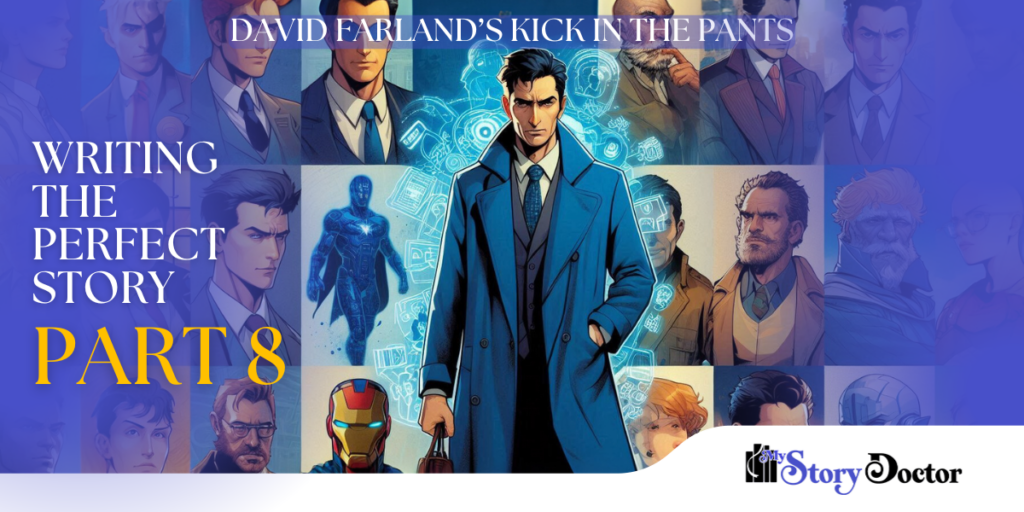
In writing a novel, one must consider, “What makes a perfect character?” Very often I’ve heard writing instructors mention that we should create “strong” characters. After thirty years of writing, I still don’t know what that means—and neither do they! Part of the problem of course is that there are dozens of types of characters—everything […]
David Farland’s Kick in the Pants—Writing the Perfect Story, Part 5

Over the past four days I’ve been enumerating some of the basic virtues that a perfect story—whether it be a movie, novel, or other piece of short fiction—would have. In particular, I’m going to couch this article in terms of writing today. It almost would seem to go without saying that a perfect story would […]
David Farland’s Kick in the Pants—Writing the Perfect Story, Part 4

For the past couple of days I’ve been discussing some of the positive attributes that you will find in a “perfect” story. There are a lot of things that I could discuss, but some take longer than others. Here is another one: Multidimensionality. Very often when I was reading slush for the Writers of the […]
How to Write a Novel: A 16-Step Guide

How to write a novel, from beginning to end in 16 steps. Brainstorm, develop a great character, create an antagonist, and more.
Religion in Fiction

Certain works of fiction are designed to appeal to readers with strong belief systems. But not all “religious fiction” need be religious.
Refining Your Tastes

There is a danger in exposing yourself to too much vapid art. It can weaken your judgment and erode your sensibilities, until the time comes when you see things that are merely passable, and somehow think that they’re good.
Showing, Telling, Making

the adage “Show, don’t tell” is used to beg for more information. Yet I’ve always felt that that advice is . . . imprecise.
Spectacular Settings

When I’m looking at a story, one of the simple things I look at is setting. There are so many aspects to setting, so let’s just look at a few
Being Prolific

How to make a living as an author. Being prolific is not something I think about, but it is something I can teach.