David Farland’s Writing Tips—Your Better Half

David Farland’s Writing Tips—Your Better Half

A quick judgment.

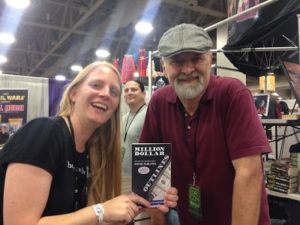
A few years ago, I happened to meet a writer at a convention who had produced half a dozen novels. I’d seen her work on a display table. Her books were self-published and full of misspellings and grammatical errors. I wasn’t impressed.

As I was chatting with her, a young lady came up, introduced herself, and said, “You’re my favorite author in the world!” Then a teenage boy came up a moment later and told how one of her books had changed his life. Then a mom came up and begged her to sign copies for her kids, who were all big fans.

That taught me something. In fact, it taught me a lot of things. First of all, your grammar and spelling may be important to editors, but for many fans, those elements aren’t very important at all. 

The settings you create, the characters you bring to life, the stories you imagine into existence—those are important!

Most readers don’t care if you can do stylistic handsprings. What they want is story that grabs them, holds them, and moves them.

Your story is more than more than your imagination. 

You see, you and your writing are only half of the equation. You create a new reality in your tale. You use your imagination, your talent and hard-won skills, but then a reader comes along and brings the other half of the equation.

The reader provides his or her own imagination and life experience as they follow your story. If they’re highly visual, they might “see” the story better than you do. That’s why we hire illustrators to design the covers.

It the reader hears better than you do, they may supply nuances of tone and character voice that you couldn’t possibly capture.

If they’re passionate, the reader may “feel” the story more deeply. I recall one woman who stopped me in a grocery store years ago to thank me for a story that I’d written. With copious tears streaming down both sides of her face, she explained how deeply it had touched her, and she sobbed so badly, I frankly worried that we’d have to send her home in an ambulance.

In short, it is possible for a fan to “read” a much better story than you can “write.” The reader brings his or her own experience and inventions to a tale, and thus in every case, a tale is richer and more nuanced than you imagine.

Of course, not all readers will connect well with you. Your worldview may not fit with theirs; your word choices might seem strange and hard to understand; your tastes might seem off or outlandish. Since some people won’t be able to connect with you easily, you may have to struggle to learn how to connect.

Our job then, is to anticipate the reader’s needs, wants, and tastes to the best of our ability. We need to imagineer a story—provide nuances, depth and surprises to a tale—that will excite the reader’s imagination.

You’ve heard me say that “My wife is my better half.” In a storytelling partnership, you always need to respect your reader, and treat them as if they are your better half.


Now available in hardback: THE WYRMLING HORDE, book 7 of the Runelords Series.

Learn about Dave’s writing workshops in April at www.davidfarland.net

Ready to revolutionize your storytelling journey? Join our 100-day writing adventure today!
Claim your FREE copy of ‘Daily Meditations: Writer’s Tips for 100 Days’ here!

Leave a Reply

Did you like this writing tip?
Click below to share with your friends

Related Posts
how to get a book published
David Farland

How to Get a Book Published 

Are you looking to publish a book? Let me tell you how to get it done.  Today, there are two paths to publishing: traditional publishing and self- (or independent) publishing.  

READ THIS POST
david farland jackie chan
David Farland

How to Build a Better Outline For Your Novel

You probably wouldn’t sink a million dollars into building a home without a blueprint. You certainly wouldn’t begin creating something as intricate as a cathedral without detailed plans. So why would you sink a year or two into composing a novel without plotting it?

READ THIS POST
how to write a short story
David Farland

How to Write a Short Story

As lead judge to the world’s largest competition for sci-fi and fantasy short fiction, David Farland can tell you exactly how to write a short story that’s a winner. The

READ THIS POST
how to write a book
David Farland

How to Write a Book

If you aren’t excited about a novel, chances are excellent that you’ll lack the energy to finish it. Your subconscious will rebel at the idea, and you’ll just go through the motions, wishing that you were working on another project. So you have to find story ideas that thrill you. You have to write from the heart.

READ THIS POST
How to write a book
David Farland

How to Write Your First Five Pages

How to Write Your First Five Pages:
1. From the very first sentence, I want to see that you’re not just a competent writer, but a skillful one.

I want to see that you have a way with words, so that I feel as if I’m in the hands of a professional storyteller. That means that I won’t feel confused, and I won’t get tripped up by typos or beginner’s mistakes. Indeed, I want to see that you’re talented right from the first sentence. Half of the editors and agents say that they look for a great voice right out the gate, whether it be the voice of the narrating character or of the author.

READ THIS POST
A colorful light bulb in front of interlocking red, yellow, and blue gears, symbolizing creativity and productivity working together.
Tammy Burke

Brainstorming for Stories: How to Turn Sparks into Worlds

Brainstorming is one of the most magical—and challenging—parts of being a writer. Ideas may arrive in a rush or drip in slowly, but either way, they form the first threads of story. The truth? Waiting for inspiration won’t always serve you. Instead, the key is to explore how to spark fresh ideas from familiar tropes, surprising “what ifs,” and creative collisions. Originality doesn’t mean inventing something brand new—it means putting your unique spin on timeless patterns so readers experience them as both familiar and exciting.

READ THIS POST
A figure in a bright red cloak walks across a black-and-white field toward a tree whose shadow stretches long across the ground. The word “Foreshadowing” appears in dark red letters to the right.
Tammy Burke

Foreshadowing in Writing:

Foreshadowing is the art of planting clues that make your story’s twists feel both surprising and inevitable. Learn the different types of foreshadowing, strategies for layering clues, and how to test your twist so it hits the perfect balance.

READ THIS POST
Stone statue of a robed woman, captured against a dramatic sunrise sky with soft orange and blue clouds, symbolizing inspiration and waiting.
Special Guest

Why Your Writing Muse Isn’t Your Friend

Too many writers wait for the writing muse to return, convinced that inspiration is the only way forward. But waiting keeps you stuck, staring at the page. The truth? Momentum is born not from longing, but from action. Start writing, and the muse may find you already at work.

READ THIS POST
No more posts to show

Wait, before you go… Be sure to grab a FREE copy of Dave's Proven Writer Tips for 100 Days!

Daily meditations Writer Tips for 100 days book image

Enter your name and email below to get it delivered straight to your inbox!

Brandon Sanderson
Brandon Sanderson#1 New York Times bestselling author of The Way of Kings and Mistborn
Read More
"I still use the writing techniques he discussed, and constantly reference him and his instruction when I teach creative writing myself. . . His explanations led me directly to getting an agent, and subsequently, my first book deal."