

Continue reading at the end to find out our extra special guests coming to Apex Writers including two New York Times Bestsellers!
Finding the Courage to Dream Big
Attention all you dreamers out there, yes that means you. As you may have heard, NaNoWriMo has started, the annual National Novel Writing Month that has been held since 1999 and has helped more than 8000,000 novelists complete 368,000 novels. As Ellen Johnson Sirleaf once said, “If your dreams do not scare you, they are not big enough.” Today, let’s talk about dreams and how to turn them into a reality.
You may not realize it, but as writers, we are all on the same journey. We all start as wannabes, hoping to amaze audiences with our eloquence and powerful tales, and so we set out on a quest to become “writers.” Some of us take only a few steps along the path before we give up.
Others Become Legends

There are a lot of fears that we face along the way. One of the most basic fears is the fear of criticism. I was terrified to even admit that I wanted to write at age 16, and didn’t willingly show anyone my first story for two years. I know writers who still won’t show their work at age 50.
Some writers are so afraid of criticism that I’ve seen then pull perfectly good stories from magazines after acceptance. In fact, many years ago, one of my favorite stories ever in the Writers of the Future contest was pulled by the author for . . . reasons that I’ll never understand.
Recently, a friend of mine wrote a fine novel but was afraid to send it to a major publisher. He went to a small local publisher instead, and I’m hoping that he will have a great career, but it may be hard to overcome that handicap.
I know one great author whose nerves bother her so much that she has to vomit before she speaks in public. You’d never guess it from her mesmerizing speeches. I know another fine author who for years couldn’t even begin to put words on paper until he was good and drunk.
And so it goes. We all have fears, but they don’t go away. Neither do our dreams.
So What Can We Do?
The best thing you can do is to face those fears. Acknowledge them. It feels a little better when you admit to them in public.
I once had a high school English teacher who confronted me. She said, “You don’t know it, but you’re a writer. You have to face that fact. You have to prepare for it. Someday it’s going to hit you, and the words will just come tumbling out, and they won’t stop.” At the time, I planned on becoming a physician, so I didn’t even admit that I’d secretly purchased a typewriter and was working on a novel. It might have saved some time if I’d told her that I wanted to be a doctor who wrote on the side. Instead, years later, I began writing a poem—and have never been able to stop.
So you confront your fears, and you make a plan to realize your dreams. Maybe your first step is to show a story to a friend or a writing group. Or perhaps it’s time to submit a novel, or buy a book on writing, or take a class, or—you probably know what you need to do next.
Confronting your fears doesn’t make them go away, but it will build courage. That’s what courage is, confronting your fears. If you continuously confront your fears, they will diminish.
Get Over It

Are you afraid that others won’t love your story idea? Get over it. There are people who hate Shakespeare. Think of your favorite novel, then look up the reviews for it on Amazon.com or Goodreads. Someone will hate it. Remember, twelve editors rejected Harry Potter before an editor accepted it . . . and helped turn it into the bestselling novel of all time.
Small successes will do even more to help you build confidence.
I was terrified to show anyone my stories until I went to college. I took a short story to an editor at the writing lab at BYU and asked her to teach me how to handle some of the tricky punctuation problems. She began reading, and after two pages quit making any editing marks at all. Instead, she laughed in the right places, became terrified in the right places, then burst into tears at the end, and said, “If you write this well, no one gives a damn whether you know how to punctuate.”
I realize now that she didn’t do much to help me punctuate any better, but she did help me overcome my fear of showing my work to others.
So I entered the story into a contest, and won a small cash prize. But that small success really helped fuel my dreams, and within eighteen months, I got my first multi-book contract.
As a writer, I suspect that I know what you really want. You want to learn to put words on paper in such a way that your stories feel magical, so that they ultimately both transport and transform your reader. That’s what most of us really want, in our hearts. Admit it.
“If your dreams do not scare you, they are not big enough.” Dream big, and face your dreams.
If you’d like more motivation, I’ve created a course called “The Story Puzzle” which you can buy individually, or as a bundle on mystorydoctor.com. For those of you who want even more help to get motivated, come to apex-writers.com and join our writing group where we will be holding daily writing sprints where authors work together to create their novels, get individualized feedback, and grow stronger as a community together.
Happy writing,
David Farland
P.S. keep reading to learn about some special guests coming soon to Apex Writers!
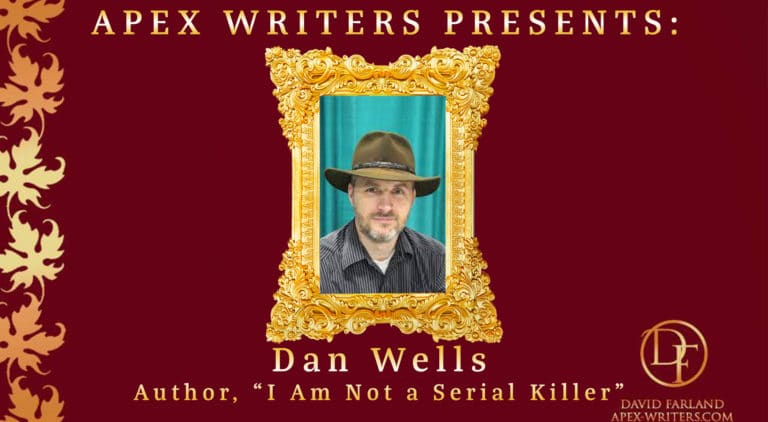
Daniel Andrew Wells is an American horror and science fiction author. Wells’s first published novel, I Am Not a Serial Killer, was made into a movie in 2016. A former student of David Farland at BYU, a true hometown hero for the state of Utah.
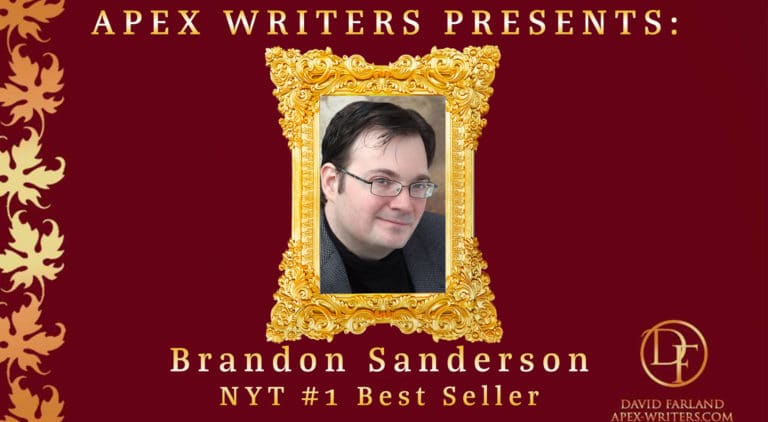
If you read fantasy and sci-fi, chances are you’ve heard of Brandon Sanderson, whether that’s from The Way of Kings, Mistborn, Skyward, Steelheart, or Alcatraz vs. the Evil Librarians. Brandon has become one of the most recognizable authors of the 21st century, and now he’s coming to www.apex-writers.com