
Crafting Your Masterpiece: Expert Guidance for Fiction Writers
MyStoryDoctor.com is the first and last place you should visit for the best writing tips on the web.
Writing a book can be a daunting task, especially if you’re not sure where to start. Google can help you to a point, but how do you know the sites you visit are reputable and offer advice worth listening to? International bestseller and acclaimed writing mentor David Farland, is on a mission to create your one-stop shop for writing advice, starting with his regular column, #WritingTips.
Tips on writing can encompass everything from the art of writing itself, to publishing and even managing your writing career. Here at MyStoryDoctor.com, we aim to address all these issues in our #WritingTips column.
As a contest judge, I see a lot of stories. Very often the new author seems to be preoccupied with just “writing.” They let their imaginations take them where they will in a scene. So they tend to overwrite in one of several ways.
They may spend time exploring the nooks and crannies of a setting, or creating entire billion-year histories. They might relay relatively unimportant information about a characters’ inner motivations, or over-write rather trivial dialog. They may spend time playing with words, trying simply to write beautiful metaphors or working to be witty, or simply trying to capture a mood or tone.
The results can sometimes be surprising and a bit gratifying, but most often the scene feels bloated, overwritten. Taking time to learn writing skills from qualified teachers will save you a lot of heartache once you start trying to find an agent and publisher for your work.
You can access David Farland’s #WritingTips on Facebook, Twitter, on DavidFarland.net and here at MyStoryDoctor.com.
Dave also recommends other reputable resources like the Writing Excuses Podcast, Grammar Girl and DailyWritingTips.com.
David Farland’s Tips for Writing a Bestseller
Writing a book that will rocket to the tops of the bestseller lists is entirely possible. It simply requires that you go about it in a thoughtful way and encompass all the elements that bestselling fiction involves.
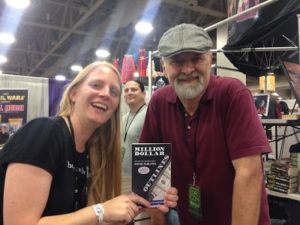
Here’s some tips to get you started, but for more information, check out my book, Million Dollar Outlines or, better yet, register for one of my online workshops.
- Know your genre and what’s selling. If the market is saturated with teenage vampire books, then don’t let it surprise you if your teen vamp book doesn’t sell. Your job is to see into the future to the next big thing. Watch the trends and research what agents are looking for to make sure that you’re writing something that has market value.
- Devise a powerful opening strategy. The most successful books utilize one of two strategies, or a combination of both—front-load the book, giving the reader a massive conflict on the opening page (Brandon Sanderson’s Elantris; Robert Jordan’s prologue to The Wheel of Time) and create a mystery in the opening pages, taking perhaps a dozen chapters to reveal the main conflict (Rick Riordan’s The Lightning Thief; James Dashner’s The Maze Runner).
- Craft your story like a three-act play, with a climax at around the middle. Make sure it’s powerful and emotional so that it draws your reader along.
- Grant your readers the ultimate payoff at the end. If you’ve written a romance, make sure the love interests are together and the final kiss is one worth waiting for, etc.
- Heartily edit and revise. I can’t stress enough how important it is that you take the time to polish your novel and make sure it’s the best it can possibly be.
For more writing tips, visit MyStoryDoctor.com.
David Farland’s Tips for Getting Published
No matter how intimidating it may seem, getting a book published is possible. People do it every day, and there’s no reason why you can’t be next.
A few tips to help you on your way:
- Beware of starting your story with profanity, sex, or extreme violence. As an editor and writer, I want my books to appear in national markets. So I want librarians and school teachers to pick up the books and recommend them wholeheartedly. With rare exceptions, books that sell well tend to have something of a PG rating.
- Never put a cover illustration in with your manuscript. If you’re writing a fantasy, it is all right to put in a map, but make it a good one.
- Format your manuscript properly. A lot of authors don’t bother to format their manuscripts properly. Years ago, I used to think: “Okay, so these writers are novices. They don’t know the rules. I’ll give them the benefit of the doubt.” But over time I learned that people who hadn’t learned to write in manuscript format usually had fatal flaws in their story. They hadn’t practiced the craft enough to become publishable. So when I see a manuscript that isn’t formatted properly, it raises a red flag.
- Never start a book with a list of twenty or thirty characters, or a list of every place in the book, or a dictionary of special terms. Your tale should instruct the reader well enough so that it can be enjoyed without those things.
I cover everything you need to know to develop a bestselling story idea, write the book, then how to get a literary agent, get a book deal—and even how to move on beyond the book deal. Enroll in my online workshops at MyStoryDoctor.com.
To embark on a 100-day writing adventure that will reshape the way you tell stories!
Click here to get Daily Meditations: Writers Tips for 100 Days FREE!