
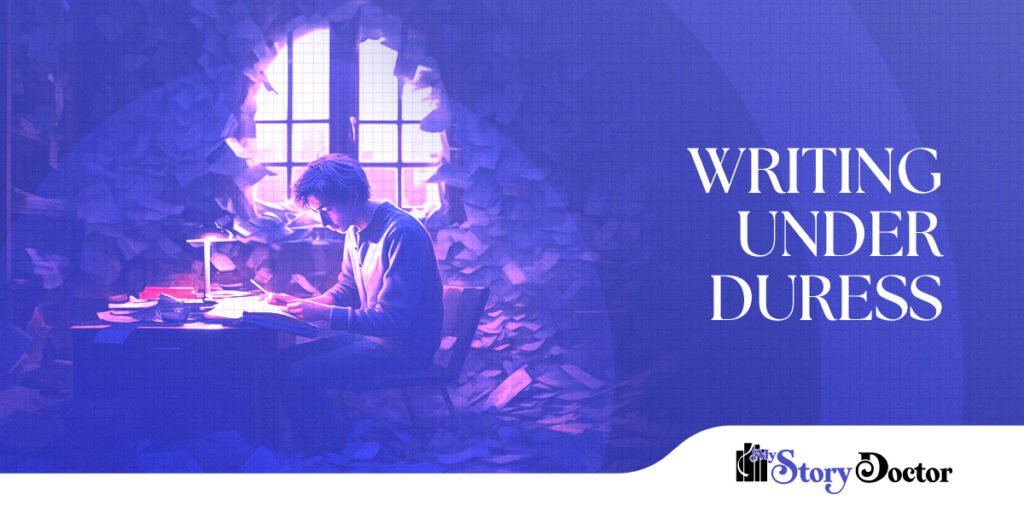
When a writer sits down to compose, the less stress he feels, the better. Every writer knows this. When you’re writing, you sit down and try to go into a trancelike state where you see, hear, smell, feel, think, and do what your protagonist does. It requires a great deal of focus.
But the more stress that you’re put under as an author, the more difficult it becomes to enter that trancelike state, and as every writer knows, if you try to write and you’re not in that focused state, you write poorly.
Stress kills creativity. It always kills creativity, and if you get put under too much stress, it incapacitates you as a writer.
Now, imagine that you’re an author, and you’ve got a bestselling series. You’re trying to get it finished up, and you’re put under some severe stress. Your editor in America is calling you, demanding that you get your novel turned in. Your editors in England and France and Russia are sending you gentle reminders. Your wife is off the rails. The producers who are making your television series are threatening a lawsuit. And every fan in the world is writing you letters asking when you will get it done. Some of them are not so gentle. In fact, many of those fans act like angry infants, so that you get a dozen of scathing hate mails every morning.
As the pressure mounts, your ability to write gets more and more impaired. You feel as if your creativity is drying up, and you know that what you’re getting is second-rate. This builds until you just want to go hide.
Then you get even more pressure. One popular author this past week, when asked when his next novel would be out, told a fan. “F–k off. Why don’t you just go die?” I thought that this was particularly funny because he happens to be one of my favorite authors. Heck, I’d be tempted to write him a letter and ask when his next novel is coming out, but I think I’ll try not to put any more stress on him.
And so you get very popular authors who just feel incapable for a time of getting anything done. When the stress goes away, they write like pros again.
Heck, I’m going to admit that I’ve been there. Years ago, just after the recession hit, I was in that stressful place. I had an editor that I’d had a lot of problems with, and he’d called a couple of weeks earlier to ask if I could get my next novel in earlier than expected. So I told him I’d try. At the same time, I discovered that my mother was ill, so I took an emergency flight home to check on her, and immediately took her to the hospital, where doctors performed a life-saving surgery. When I took her to her home, I decided to stay with her for a few weeks and help care for her while I focused on the novel, but then we got bad news: in prepping for the surgery the doctors had taken some blood tests and discovered that my mother had terminal bone cancer.
So she was on the couch recuperating from her surgery and had just learned that she was going to die. I was consoling her, holding her hand, when my editor called. He asked how I was doing, and I told him the news about my mother. He grumbled, “Yeah, well get that novel in!” Then he loudly began to threaten me, saying if I didn’t get that novel turned in immediately, he was going to demand my advance back and that he’d never publish me again. Heck, he did everything but pull a gun on me.
Now, as you can imagine, being threatened is no fun. An author can’t write well under that kind of duress, and any good editor should know that this is the wrong tactic to take. Especially during the recession. I had learned just a couple of weeks earlier that the investor who had handled my life-savings was going bankrupt, and those savings were gone. So that added to the stress.
I got stressed out. Every time that I tried to work on my novel, I couldn’t enter my writing zone. I knew that I could write something, but every time that I tried to compose, it just felt mechanical and . . . not at my peak. I didn’t want to pen a second-rate book. I knew that I needed to de-stress.
Really, I just got so mad. I considered calling my publisher and demanding a new editor, but really I did want to finish the novel. And yet I had to set the project aside for a long time. (I’ve now been able to de-stress to the point that I should finish it in the next few weeks.)
But when I look at immensely popular authors like George R.R. Martin, I understand pretty well what they’re going through. They literally need to get away from the stress, go find a cabin up in the woods that has no cable, and just sit and write, unhindered by queries from fans, editors, and movie producers—and sometimes even that might not be enough. Stress kills creativity.
Lately I’ve learned some more advanced techniques for de-stressing, but my point is this: In your life as a writer, you’re dealing with many of these same issues. You have competing work demands, while at the same time you might be stressed by issues with your finances, family, or medical health. When that happens, you need to figure out how to de-stress.
For those of you who are big fans of an author, please try to understand that they really do want to get that novel done. Don’t send nasty letters. Your author is probably getting enough of those from their editors, producers, attorneys, and so on.

Ready to revolutionize your storytelling journey? Join our 100-day writing adventure today!
Claim your FREE copy of ‘Daily Meditations: Writer’s Tips for 100 Days’ here!